

Firing a weapon is simple, in theory. Pull a trigger, press a button, or fly a plane; fighting takes place only in the here and now.
Or does it?
Putting a weapon in someone’s hand takes many hands across many countries in its transformation from raw materials into arms. Today, nearly every country relies on international arms trades to supply their military forces, and nowhere is this reliance clearer than in the Israeli-Palestinian war. While Israel has a strong weapons manufacturing industry, they also purchase enormous amounts of weaponry from foreign producers. For instance, estimates place US-Israel arms trades at a minimum of $39.2 billion USD between October 2023 and April 2025, with a high likelihood that additional weapons were being transferred. Even with trades costing billions, the US only constitutes 69% of Israeli weapons imports; many more were supplied by other nations. The impact of foreign weapons on the Israeli offensive, particularly aircraft and explosives, increases the scale of the war; many of the weapons destroying Gaza likely came from elsewhere in the world.
The states that directly supply Israel’s arms share close diplomatic ties with them, motivating their support of the Israeli war effort. Israel’s main weapons importer is the United States, and the two nations have been closely allied since Israel’s 1948 establishment. The US’s commitment to Israel’s defense furthers their own national goals; the two are allied against Iran, giving the US strategic reasons to aid Israel, and Israel’s status as the only democracy in the Middle East (although this claim is highly contentious) generates more US aid. Additionally, their decades of alliance and close trade have built numerous political and financial motives for the US to continue its support. Germany, who supplies 30% of Israel’s arms imports (including air defense and communications equipment), is also committed to Israel’s continued existence. German relations with Israel form a “cornerstone of German foreign policy;” specifically, German responsibility for the Holocaust motivates their policy of support for Israel, explaining the volume of military technology that they continue to trade. Other primary suppliers, such as the UK and Italy, also share close diplomatic relations with Israel. These nations’ close commitments to Israel explain their part in placing weapons into Israel’s hands.
However, these countries are only one step in the arms trade network; they provide the finished weapon, but the weapon’s ammunition, controls, and triggers – and the tools for creating them – must be traded too. Israel’s suppliers all trade with other nations for materials and tools to manufacture their weaponry. For example, China holds monopolistic power over 30 of 44 “critical minerals” used in batteries, semiconductors, and bombs, as well as minerals that create manufacturing tools. Thus, Israel’s suppliers trade with China for raw materials to manufacture their arms. Many suppliers (notably, the US) also trade with Estonia, Japan, and Malaysia for “rare earth components” to manufacture their weaponry. Other involved countries, including the UK, trade technology and weapons designs with nations that supply Israel.
Raw material becomes a weapon fired via an international process of mining, refining, manufacturing, and trading. Neodymium, for example, is a magnet mined almost exclusively by China and Australia and used to build aircraft motors. Once mined, it is refined – usually in China – and transformed into metal alloy. Next, the alloy is used to manufacture a magnet in a process that may occur in an EU nation. The finished magnet is traded, perhaps to the US, and used to build an aircraft that is traded to Israel and used in their war. Nearly all of Israel’s aircraft use neodymium motors, yet Israel itself does not build them. Instead, an international supply chain spanning four continents manufactures the weapons that fuel their war effort.
Yet not all of these supplier nations support Israel. For instance, China, the global largest raw materials supplier, has repeatedly condemned its actions since October 2023. Malaysia, who provided 11% of the US’s rare earth compounds between 2019 and 2022, recognizes Palestinian sovereignty only. In fact, in July 2026, Malaysian prime minister Anwar Ibrahim announced that any “Israeli nationals” found in Malaysia would be deported. Yet Malaysian raw materials supply the Israeli war effort via trade with the US.
The interconnected nature of arms trade, including raw material, technology, and manufacturing, means that many nations play a part in firing a weapon. Thus, external factors in any of these nations could upset weapons trade and prevent that weapon from firing, even if the interruption occurs in a nation that does not directly supply the weapon. For example, the recent conflict in Yemen severely interrupted their oil exports: since the Houthi conflict began, exports have heavily decreased. The largest importer of Yemen oil is China; without that oil, Chinese manufacturing and industrial goals may slow. The impact may spread, as Chinese exports are essential to many economies. Specifically, China exports enormous amounts of raw material to the US, who builds weapons that supply Israel; thus, seemingly unrelated conflict in Yemen may disrupt Israel’s arms supply. External politics also play a role: since the US went to war with Iran, other nations have limited or stopped arms exports to the US, decreasing their arms supplies and thus impeding Israel’s war effort.
The internationality of the arms network means any conflict or trade obstruction could impact any other conflict or obstruction, creating a cascade that affects multiple continents and wars. Additionally, this network means that a seemingly far-off conflict may both be enabled by and impact trade within any other nation.
However, it also means that countries have much more influence on foreign conflicts, even without joining the fight. For example, many nations have pressured Israel to end their genocidal actions in Palestine: while these efforts have not succeeded, they have potential to interrupt the Israeli war effort if nations that supply Israel’s arms or raw materials cease trading. This influence complicates international security: if states control each others’ arms supplies, they hold significant power over each others’ abilities to threaten and wage war. Thus, states with more trade or economic power may be able to gain influence and impose their international goals at the loss of other states’ security and autonomy. An interdependent trade network, particularly one concerning the production of weaponry essential to state security, creates a system wherein states rely on external supplies to protect themselves, putting themselves at risk should their trade partner wish to pursue war or push an agenda.
Firing a weapon in Palestine may appear only to require Israeli orders, but in truth it necessitates US trade, Malaysian raw materials, Chinese manufacturing, and more. In a globalized economy, these trading nations have much more power over each other than in decades previous; without foreign technology or international manufacturing, or simply due to a supply-chain interruption such as the US-Iran war, that weapon may never reach Israel at all. Thus, states may try to use this leverage to influence the supply of arms to and the course of a conflict, which could either benefit those in need or could create a cascade effect that cripples a supply chain and sets a dangerous precedent for interference in international conflict. States may have the ability to use their leverage; the question remains as to whether they have the responsibility to.
Edited by Lola Rubin
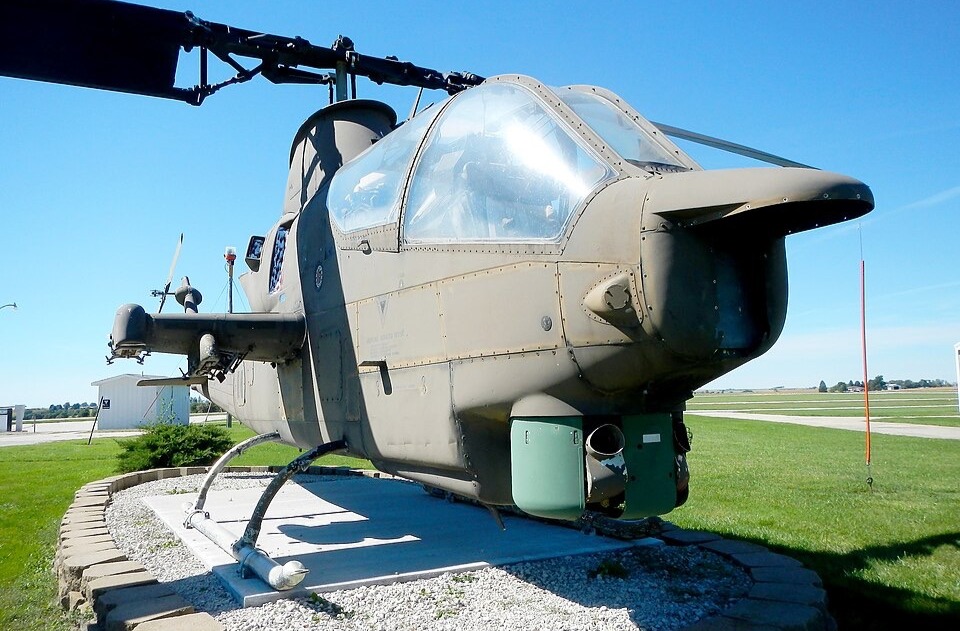
Featured image: Shows a Bell AH-1 Cobra helicopter, developed in the US in the mid-1900s and used by Israel in their war against Lebanon. Photo by James Friedebach in the public domain via Wikimedia.
