

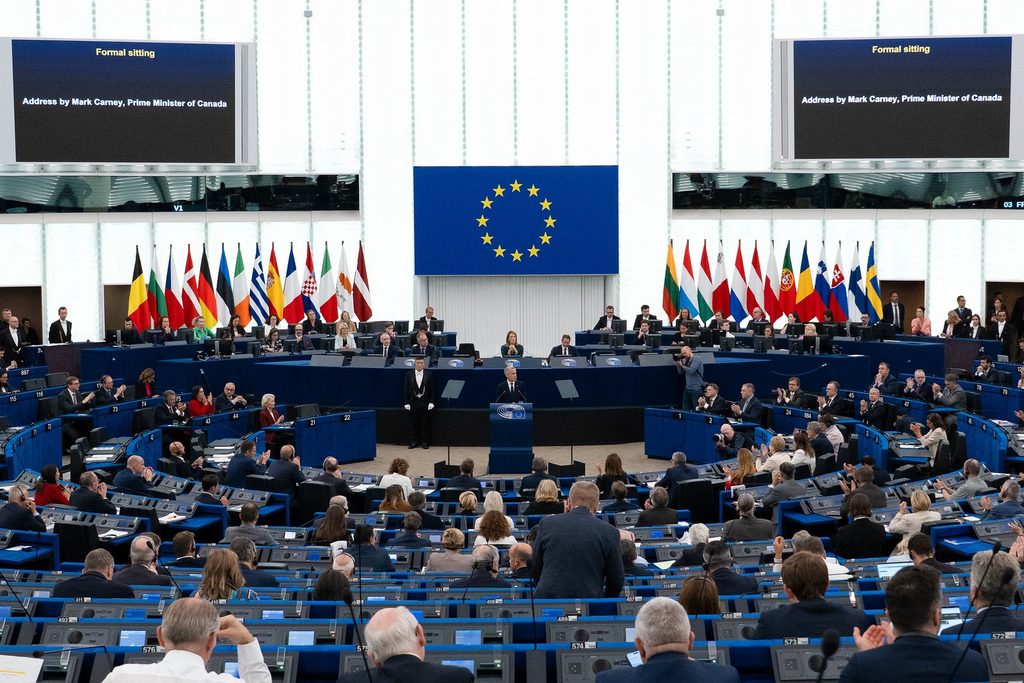
A title of “associate member” of the European Union was offered to Canada by European Commission President Ursula von der Leyen on September 16 at the annual state of the European Union address. The offer was framed as a reimagining of the partnership, which Ottawa has responded to positively. While the title lacks meaning right now, it should be interpreted as a strong mutual desire to formalize a closer relationship. Canada’s potential “associate membership” with the EU has largely been reported for its trade implications amid Canada’s ongoing trade war with the US, but Carney has expressed interest in a “unique security and economic alliance,” raising questions about how the partnership would affect security relations. Canada and the EU already have significant defense agreements, so the partnership would only strengthen their security alliance if there were meaningful advances beyond preexisting deals.
Despite interest from both sides in forming a closer partnership, the term “associate membership” currently has no precedent or fixed definition, creating significant uncertainty on all sides. Canada’s geographic location makes it ineligible to become a member, a concept also opposed by Prime Minister Mark Carney. Without a prior example or a solid definition when introducing the concept, the role currently functions more as a powerful signal than as a mechanism for policy initiatives.
Security collaboration between Canada and the EU is not a new idea. In 2015, Canada became the first partner country with which the EU established a regular security dialogue, and officials have continued to meet since. In the summer of 2025, a Security and Defense Partnership was formalized. It consolidated existing cooperation into a single formal framework that frames “bilateral dialogue and cooperation across the full security and defense spectrum.” The partnership involves a dedicated annual Security and Defense Dialogue, the same dialogue that began in 2015, and the continuous development of new and existing topics of shared interest. The agreement also commits to cooperating on issues outside the two regions. Listed, for example, are aid to Ukraine, maritime security, and peacekeeping operations. The Security and Defense Partnership also focused on joint research and analysis of technological advancements, including AI, hybrid threats, cyber issues, and information manipulation and interference. Although the partnership outlines broad areas of cooperation, it creates few binding obligations. However, it sets up the option for stronger, more specific Canada-EU agreements, such as Canada’s involvement in the Security Action for Europe (SAFE) in June of 2026.
Canada’s participation in SAFE is a direct result of the Security and Defense Partnership and provides a more concrete way for Canada to engage in security matters in the EU. Adopted in May 2025, SAFE established an extensive loan program for EU members to jointly purchase defense equipment, aimed at reducing costs and accelerating rearmament. Although the loans are available only to EU member states, the EU was open to arrangements with any country with which it had signed a defense partnership, giving Canada a way to participate in SAFE. This arrangement allowed Canadian companies and products to participate in procurement under SAFE, making Canada the first non-EU country to do so. This allows for contracts between the EU under SAFE and Canadian firms, with Canada having the option to supply and manufacture products to support EU security. The Prime Minister’s Office Statement emphasized significant economic benefits, saying participation would widen access to European markets, attract new suppliers for the Canadian Armed Forces, and “catalyze massive private investment in Canada”, creating new, high-paying jobs and growing industries. The agreement would also increase “transatlantic defense readiness,” as Canada would be the only country beyond the EU with preferential access. In practice, Canada has already begun competing for SAFE-funded contracts and has won its first through Marconi Technologies, a Montreal-based company that recently secured a contract to supply Poland with tactical radios. While the arrangement provides Canada with access and opportunity, it comes at a cost of around $16 million to participate. Further, SAFE concerns procurement, not protection or unity, allowing space for a closer relationship through an “associate membership.”
While the Security and Defense Partnership and Canada’s participation in SAFE have integrated industrial supply chains and increased dialogue on security concerns, the core question remains: would an “associate membership” with the EU fundamentally change security dynamics, or merely rebrand existing cooperation? A key consideration is how a closer relationship might allow Canada to weigh in on governance and decision-making. If Canada gains associate status without a seat at the table, it risks creating an asymmetrical dynamic. Without voting power, would Canada be bound to European defense standards and involvement in projects advancing European power? Furthermore, a new dynamic could lead to a broader military alliance. While deals like SAFE are fundamentally financial, an “associate membership” could strengthen military ties and mutual defense guarantees. While NATO arrangements already exist to protect member states, could a stronger tie between the EU and Canada go beyond NATO commitments to include greater intelligence sharing and combined military efforts? Prime Minister Carney has marketed the potential new relationship as one of increased trade and security, but without solid advances in security ties beyond existing arrangements, “associate” status may be more of a diplomatic title than true integration into the EU.
Canada’s potential shift towards a closer relationship with the EU has left many Canadians wondering how this might affect them. Will traveling to Europe be easier? Would Canada have to adopt the Euro? What does this mean for Canada’s relationship with the United States? Most questions remain unanswered. Canada under Carney has made significant strides towards diversifying its economy and trade relationships, making waves internationally for its departure from past norms. Canada’s “associate membership” seems to be a continuation of that trend, but as of now it lacks formal arrangements. Some questions may be answered at the upcoming Canada-EU summit in Montreal at the end of October. Policymakers may formalize the role and responsibilities of an “associate member” of the EU. Interested parties should also watch for how Canada plans to balance its North American commitments while strengthening transatlantic ties. Ultimately, it’s hard to know whether “associate membership” is just a symbolic title to signal on the global stage that Canada and the EU are strong allies, or whether legitimate security changes will follow, but the story certainly goes beyond a trade relationship.
Edited by Bérénice Louveau
Featured Image: “Mark Carney calls for an “alliance for the future” between the EU and Canada” by European Parliament, CC BY 4.0