

In March of this year, the Paris Criminal Court issued a historic ruling, sentencing French ISIL (Islamic State of Iraq and the Levant) foreign fighter Sabri Essid to life in prison for genocide and crimes against humanity. Essid, a central figure in French jihadist networks, was found guilty of systematic enslavement, deprivation of liberty, torture, and daily rape of Yazidis between 2014 and 2016. In September, civil party survivors were awarded damages. With this verdict, France became the sixth nation, alongside Germany, the Netherlands, Sweden, Kosovo, and Belgium, to prosecute ISIL members for core international crimes committed against the Yazidi community.
The realization of these universal jurisdiction trials relies on rigorous evidence gathering and documentation efforts led by non-governmental and civil society organizations such as Yazda and the International Federation for Human Rights. They have been documenting survivors’ testimonies, mapped enslavement routes, and have represented survivors as civil parties in courtrooms, helping to bridge the gap between the evidence on field and international justice.
While landmark universal jurisdiction verdicts in Europe provide legal recognition of ISIL’s gendered genocide, international courtroom accountability alone cannot substitute for domestic legal reform, local security stabilization, and structural justice in post-conflict Iraq. To understand how ISIL executed this gender-differentiated genocide against the Yazidis in 2014, it is necessary to retrace the post-2003 collapse of the Iraqi state and the new governance model.
The fall of Mosul in June 2014 resulted from a decade of institutional dismantling following the 2003 US-led invasion of Iraq. Evolving from Al-Qaeda in Iraq and the Islamic State of Iraq (ISI), ISIL grew into a totalitarian extremist organization that exploited Sunni disempowerment, rejected colonial state borders, and established a violent “caliphate” funded through extortion and kidnapping.
The path toward collapse began in May 2003 with two important decrees issued by the Coalition Provisional Authority. Decree n°1 called for a de-baathification policy to remove Saddam Hussein’s Iraqi Ba’ath Party’s influence. The 2nd decree dissolved 29 state institutions, including the Iraqi army. Overnight, hundreds of thousands of soldiers were left unemployed, creating a pool of recruits for the Sunni insurgency. This initial vulnerability was deepened when US forces led aggressive nighttime raids based on unverified local intelligence, humiliating the people of Mosul and creating a long-term resentment toward occupying forces.
Exploiting the growing hostility, Al-Qaeda in Iraq (AQI), helped to orchestrate violent sectarian polarization and coordinate nationalist groups. At the same time, the American detention center, Camp Bucca, worked as an operational platform where insurgent leaders could meet extremist ideologues. This breakdown accelerated under Prime minister Maliki, who blocked the creation of Sahwa (“awakening”) councils in Mosul, which had successfully suppressed AQI elsewhere in Iraq, leaving the local population without trusted protection and enabling ISI to impose a parallel extortion economy. Maliki’s weaponization of Anti-terrorism law n°13 and the crackdown on Sunni protests, notably the Hawija massacre, permanently shattered political trust. By June 2014, these ten years of division reached a breaking point. When two divisions of Iraqi security forces abandoned their positions in the face of less than 1,000 ISIL fighters, they left citizens without any security.
On August 3, 2014, ISIL launched a coordinated military offensive against the Sinjar district, explicitly targeting the Yazidi ethno-religious minority. Encircling Mount Sinjar, militants trapped between 70,000 and 80,000 civilians without food, water, or medical supplies. Over 1,700 died from starvation, dehydration, and exhaustion, 93% of whom were children.
ISIL deployed a gender-based strategy designed to ensure the physical and biological destruction of the Yazidi community. ISIL’s male decimation campaign left behind at least 83 documented mass grave sites containing between 1,434 and 3,100 victims. When capturing villages, ISIL soldiers applied strict physical maturity checks, examining height, shoulder breadth, and public hair growth, to separate men and boys as young as 12 to 14. Those determined to have reached puberty were presented with a “convert or die” and executed when they refused. Mass killings began on August 3 in Siba Sheikh Khidir and Qeni, escalating to the massacre of 422 men and boys in Kocho, and the execution of 80 elderly women and adolescent boys at Solagh, deemed unfit for forced labor and sexual slavery.
Young Yazidi boys were forcibly separated from their mothers, converted to Islam, and indoctrinated to be deployed as frontline combatants. Forced isolation, forced conversions, and coerced marriages were designed to prevent births within the group and dissolve the Yazidi identity. This human destruction was accompanied by the demolition of more than 68 Yazidi temples, and sacred sites.
While men and older women faced immediate execution, Yazidi women and young girls (classified as “pubescent” as young as age 9) were registered, categorized, and transported through transit hubs across the Syrian border. To buy, sell, and trade female captives, ISIL created virtual slave markets on messaging apps like Telegram, enforcing price grids from US$40 to US$100 for adult women, and up to US$14,000 for young girls, who were subjected to daily rape, torture, and repeated resale.
The United Nations Investigative Team to promote Accountability for crimes committed by Da’esh/ISIL (UNITAD), evaluated ISIL’s campaign under international criminal law, concluding that war crimes, crimes against humanity, and genocide were committed. UNITAD established genocidal intent under the 1948 Genocide Convention through four pillars.
First, ISIL enforced a “convert or die” policy specifically targeting the Yazidi faith. Unlike Christian communities, who were permitted to maintain their religion under ISIL occupation by paying a protection tax, ISIL classified the Yazidis as “pagans” rather than dhimmi (protected under musulman state). This classification left no legal option between conversion or death.
Second, the siege on Mount Sinjar constituted a calculated effort to subject the population to living conditions aimed at its physical destruction.
Third, the systematic execution of men and adolescent boys specifically designed to annihilate both the community’s defensive capacity and its long term prosperity.
Finally, by reducing Yazidi women to sexual slavery and transferring young children to be raised within ISIL networks, the organization tried to permanently dissolve Yazidi cultural and religious identity across generations.
Over a decade later, over 300,000 Yazidis remain internally displaced, primarily across camps and informal settlements, while more than 2,000 Yazidis remain missing out of the estimated 6,000 abducted. This ongoing humanitarian crisis is further complicated by an institutional transition following UNITAD’s closure in September 2024 (under UN Security Council Resolution 2697), leaving it in the hands of Iraq’s National Center for International Judicial Cooperation. The Iraqi penal code lacks laws criminalizing core international crimes. Therefore, Iraqi courts try ISIL members under generic Anti-terrorism law and the Yazidi survivors law, erasing the gendered and religious dimension of the violence, denying survivors reparations and recognition. Furthermore, returning female survivors and children born of wartime rape face painful socio-religious stigma and legal barriers because, under Iraqi civil status laws, these children are automatically registered as Muslim, creating an identity conflict that blocks reintegration. Proposed Amnesty Law amendments also raise fears of premature perpetrator releases. Meanwhile, geopolitical rivalries between competing armed factions in Sinjar block infrastructure reconstruction and the safe return of displaced Yazidi families to their homeland.
While European trials deliver crucial historical accountability, true security for the Yazidi community requires domestic legal reform, survivor reparations, and stabilization in Sinjar.
Edited by Kendall Fagan
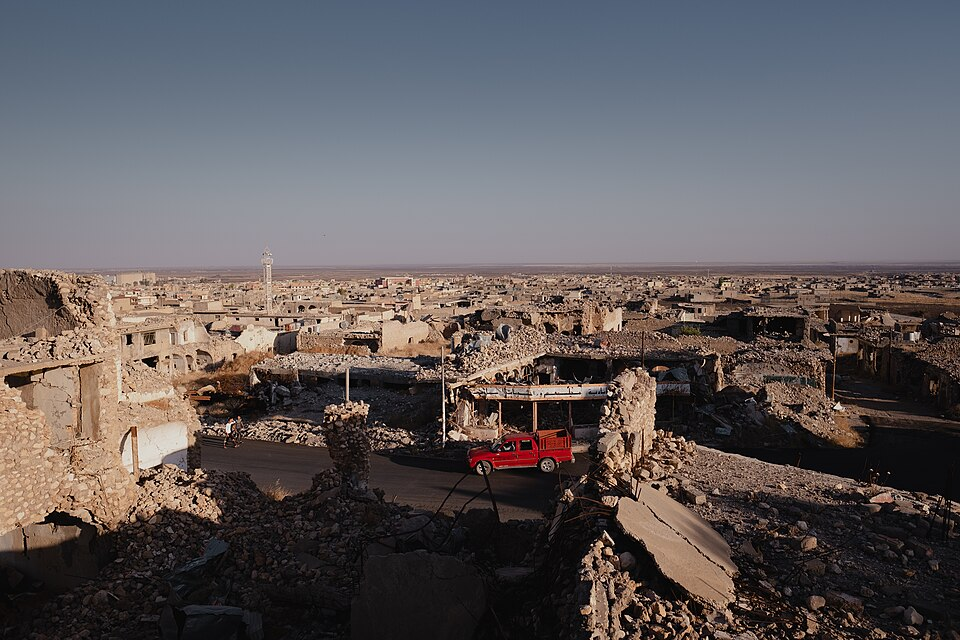
Featured Image: “Views around the city center of Shingal (Sinjar) in summer of 2019, following the war with the Islamic State.” Levi Clancy, CC0, via Wikimedia Commons
