

When navigating counterinsurgency, state actors are commonly faced with a crucial question: Can negotiations with an armed group reduce violence without granting the group political leverage? In June, the Nigerian government reportedly established a secret ceasefire with Boko Haram, a jihadist insurgent group that has waged an armed campaign against the secular Nigerian state since 2009. Primarily based in northeastern Nigeria, Boko Haram has carried out countless bombings, raids, and mass abductions for over a decade, including the internationally publicized Chibok schoolgirls kidnapping in 2014. Now that news of the agreement has reached the public, the state, which has long been reliant on military force to combat Boko Haram, finds itself in a bind. While recent negotiations have coincided with noticeable progress towards de-escalation, critics have raised concerns about the legitimacy these concessions could grant Boko Haram. The government is forced to reconcile the need for immediate relief with public opposition to any form of collaboration with Boko Haram.
The immediate humanitarian benefits of a ceasefire provide a compelling justification for continued diplomatic engagement. The negotiations have reportedly coincided with a decline in regional violence and could open the door to alternative conflict resolution tactics, as military force alone has proven unsuccessful. Regardless of how these lines of communication could reconfigure Boko Haram’s status and legitimacy, an official agreement pausing the ongoing and devastating violent attacks undeniably provides immediate relief to victims and affected communities. Nigerians in the northeast have long faced the highest levels of attacks in the country, and they are more likely to support prioritizing immediate security over broader strategic objectives than Nigerians located further from the conflict. With the ceasefire came the simultaneous release of 360 abducted villagers, secured by a nearly $5.2 million (CAD) ransom payment from the Nigerian government. By establishing greater diplomatic relationships with Boko Haram’s leaders, the Nigerian government can instill a measure of answerability. Additionally, opening channels of communication can allow the Nigerian government to gain insight into the structures and tactics of Boko Haram. Officials are better able to observe dynamics, motivations, and ideologies at play within the group and use this information to sharpen their maneuvers.
However, there are inherent risks to openly negotiating with an insurgent group. Nigeria has a history of “under the radar” communication with Boko Haram despite maintaining a strong public stance committing to a military defeat. Past attempts at dialogue and negotiations have repeatedly failed, often due to information leaks within the government and military. Opening channels of communication provides a degree of legitimacy to Boko Haram and could incentivize future violence. A sizable ransom payout from the government could set a precedent that encourages insurgent leaders to pursue mass kidnappings for profit. If leaders know terrorist acts can gain them entry to the bargaining process, they will continue to use violence as a leveraging mechanism. Along with financial losses, these negotiations could also be hurtful to victims of Boko Haram’s attacks, and a perceived denial of justice could be regarded as a betrayal by their government. If the Nigerian government grants amnesty to Boko Haram actors, victims might feel a sense of erasure and lack of accountability. This report will likely come with high political costs for Nigerian government officials. President Bola Tinubu announced an expansion of the military in July, likely as a display of state strength, an image that has now been tarnished by the exposure of the negotiations. Nigeria’s upcoming 2027 elections add another dimension to this dilemma, as officials must now regain public trust and establish transparency with constituents in order to win.
Nigeria’s own past experience sets a precedent for negotiation policies. The 2009 Presidential Amnesty Programme in the Niger Delta offered an unconditional pardon and cash payments to rebels in the oil-rich regions who agreed to disarmament and rehabilitation. These concessions sharply reduced attacks on oil infrastructure; however, the plan failed to pay close attention to the underlying grievances: rejection of a secular government, westernized politics, economic inequality, and corrupt patronage systems that some Muslims felt excluded from. The Nigerian government’s short-term solution was inadequate at addressing ideological points of contention and internal failures corrupting its own political system. Critics argued that the payouts ultimately incentivized violence, and militancy resurfaced in the following decade. The Programme’s failures ultimately demonstrated that negotiated relief must be paired with longer-term reform.
It’s clear that neither militancy nor secret dialogues alone can eliminate the threat of Boko Haram in Nigeria. This calls into question the limits of relying primarily on military force in counterinsurgency. Insurgent groups are not limited in the same way a state actor is. Governments have international standards to comply with, are more accountable to their constituents, and must meet expectations to prioritize civilian safety even while pursuing a military defeat. Insurgent organizations often exercise unconstrained authority over captured territories, operating largely free from institutional oversight or accountability. Military force alone has been unsuccessful in defeating Boko Haram, suggesting that the Nigerian government should consider shifting its policies in dealing with the conflict. They may consider using various tactics simultaneously and practical safeguards for engaging with insurgent groups. These could include mandates for cessation of violence as a prerequisite for formal talks, limiting ideological debate in negotiations to avoid escalation, and handling initial negotiations via intelligence services to minimize risks. A combination of sustained military pressure, tactical communication, and more public transparency could help reduce violence and recover public trust in the wake of these negotiations. Armed forces can suppress violence temporarily, but long-term success will require political, economic, and social roots of the conflict to be addressed. Addressing internal instability, specifically corruption, operational inefficiencies, and intelligence leaks, is crucial for Nigeria to build a stronger counterinsurgency framework.
Ultimately, the ceasefire is not necessarily a concession or a victory. Rather, it can serve as a gauge for weaknesses in the government’s counterinsurgency approaches and perhaps provide an opening for greater influence from the Nigerian public. A strategy that pairs sustained military pressure with safeguarded negotiations and greater transparency offers a more credible path than either approach alone. Counterinsurgency is complicated by the political implications of the conflict and is not purely a military struggle. The Nigerian government is pressed to provide physical security, developmental programs, and functional services to its constituents. Political actors will have to use discretion as they navigate the fine line between confidentiality and transparency going forward. It remains unclear what the implications of this ceasefire are, and Nigerians, as well as foreign actors, will be watching closely to see what consequences emerge.
Edited by Penelope Cramer
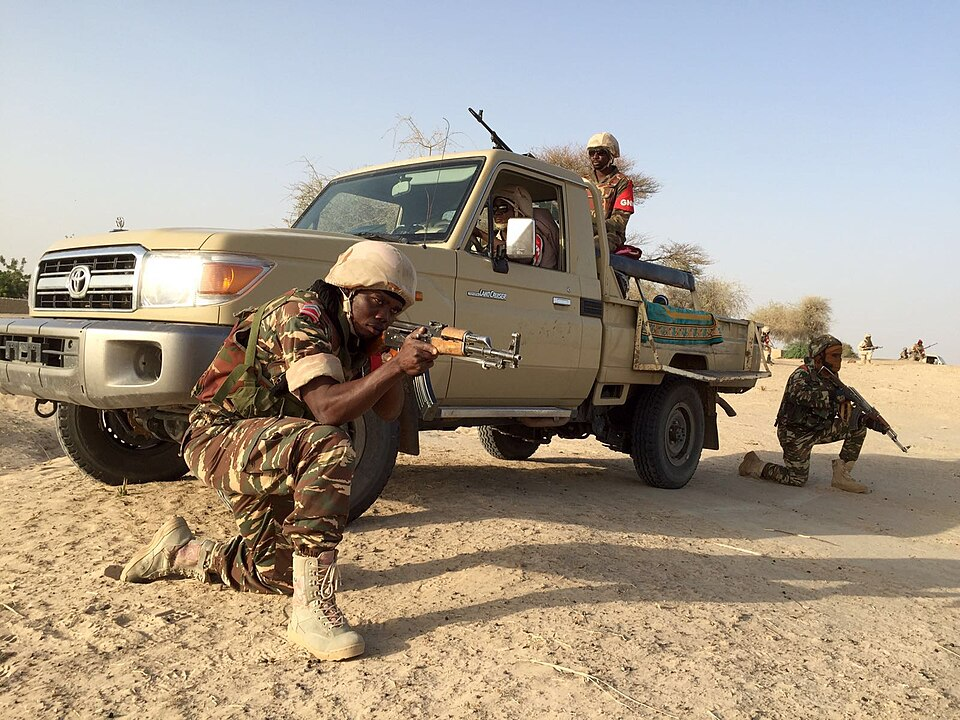
Featured Image: “In the village of Zenam Kelouri, Nigerian soldiers carry out a show of force as part of their fight against Boko Haram, on February 29, 2016.” (VOA/Nicolas Pinault), Public domain, via Wikimedia Commons.
