

In 2024, women made up just 7% of negotiators in major peace processes worldwide, despite decades of international commitments to their inclusion, including the United Nations Security Council adoption of Resolution 1325. Resolution 1325 was installed in October 2000 with the goal of establishing the foundation for the Women, Peace and Security (WPS) agenda and formally recognizing women’s essential role in conflict prevention, peace negotiations, and post-conflict reconstruction. However, over 25 years later, this challenge has extended beyond women’s continued underrepresentation. International institutions may promote women’s inclusion, but there is a risk that representation becomes a box-checking exercise, where the number of women present is treated as evidence of progress without examining their actual influence. Securing women a seat at the negotiating table is not necessarily the same as giving them the power to influence what happens there.
Numerical representation provides an accessible measure of progress, but the proportion of women participating in negotiations does not necessarily reflect the authority they hold. Meaningful participation requires opportunities to shape negotiating priorities, contribute to decisions, and influence the terms of peace agreements. In UN Security Council Resolution 1325: A Feminist Transformative Agenda?, Jennifer Klot examines the transformative potential of the WPS framework, emphasizing the importance of feminist organizing and challenging existing institutional structures. Laura Shepherd’s research on the production of Resolution 1325 highlights how institutional power and authority shape international security policy. Together, their work questions if women are included in negotiations but cannot challenge existing priorities, how meaningful is that inclusion? Representation is essential to addressing women’s historical exclusion, but it should be understood as a starting point rather than a definitive measure of success. Without corresponding decision-making authority, greater representation risks becoming a symbolic achievement rather than a substantive change in how peace is negotiated.
Colombia’s peace negotiations between the government and the Revolutionary Armed Forces of Colombia (FARC), which culminated in the 2016 peace agreement, illustrate how women’s participation can move beyond numerical inclusion. When negotiations began in 2012, women were largely absent from formal negotiating teams, despite women’s organizations having played significant roles in peace activism and advocacy. According to the Council on Foreign Relations’ Colombia case study, only one of the original 20 negotiators was a woman. Following sustained advocacy by women’s organizations, participation increased and the negotiating parties established a Gender Subcommission in 2014 tasked with incorporating a gender perspective into the peace agreement. Virginia Bouvier’s research on women’s roles in Colombia’s peace process emphasizes the importance of women’s organization both inside and outside formal negotiations. Colombia’s progress therefore reflected more than an institutional decision to include women, rather it was the result of years of political mobilization demanding greater influence over the peace process.
The significance of Colombia’s approach becomes clearer when examining how women’s participation shaped the resulting agreement. Women’s organizations and gender advocates helped bring attention to conflict-related sexual violence, victims’ rights, political participation, and the gendered consequences of displacement and land inequality. The Gender Subcommission contributed to incorporating gender considerations throughout the 2016 agreement rather than treating women’s concerns as a separate issue. For example, the agreement incorporated gender-sensitive approaches to rural reform, including attention to women’s access to land, alongside provisions addressing victims of conflict-related sexual violence. These provisions illustrate how women’s advocacy helped broaden the priorities considered within the negotiations, bringing historically marginalized concerns into the formal peacebuilding agenda. In Colombia, women’s influence was visible in what was negotiated, not merely in who was present.
Yet Colombia also demonstrates why influence over an agreement should not be confused with achieving its intended outcomes. The inclusion of gender-sensitive provisions was a significant accomplishment, but their implementation has remained uneven. The Kroc Institute for International Peace Studies has documented persistent difficulties implementing the agreement’s gender commitments, including inadequate institutional coordination and resources. This creates a further distinction between securing representation, influencing an agreement, and ensuring that its provisions produce tangible change. Even when women successfully shape negotiations, their priorities may lose influence during implementation if institutions fail to follow through. Colombia’s experience suggests meaningful participation requires sustained political influence and accountability beyond the negotiating table.
The limitations of institutional inclusion are also evident in Sheri Lynn Gibbings’s No Angry Women at the United Nations, which examines an encounter involving two Iraqi women invited to speak at an informal UN meeting. Gibbings describes how their criticism of the Iraq invasion conflicted with institutional expectations surrounding acceptable political expression, and although the women were given an opportunity to speak, their perspectives were received negatively because they challenged established institutional norms. Gibbings demonstrates how institutions may welcome women’s participation while remaining resistant to perspectives that challenge their existing priorities. Institutions value the appearance of inclusion more than the redistribution of influence; furthering creating the risk that representation becomes more performative and symbolic than meaningful.
Even now, the UN Secretary-General’s 2025 report on Women, Peace and Security found that nearly nine out of ten major peace negotiation tracks in 2024 included no women negotiators. When compared to Colombia’s experience illustrating where women’s participation has helped shape a peace agreement, translating those commitments into practice remains a separate challenge, it is evident there are shortcomings in the implementation of the WPS agenda. Women continue to face exclusion from negotiations and inclusion itself does not guarantee meaningful influence, and furthermore, addressing the first problem without confronting the second risks allows institutions to claim progress through representation alone.
More than 25 years after Resolution 1325, increasing women’s representation remains essential to addressing their historical exclusion from peace and security decision-making; however, counting women at the negotiating table cannot independently establish whether their participation has transformed the peace process. Colombia demonstrates the potential for women to influence negotiations when meaningful institutional opportunities exist, while the continued challenges of implementation reveal the limits of formal commitments. Progress under the WPS agenda’s participation goals must therefore be evaluated through both access and influence, including women’s ability to shape priorities and hold institutions accountable for the resulting commitments. Ultimately, the measure of meaningful participation is not simply whether women have a seat at the table, but whether they have a say in the peace being negotiated.
Edited by Lola Rubin
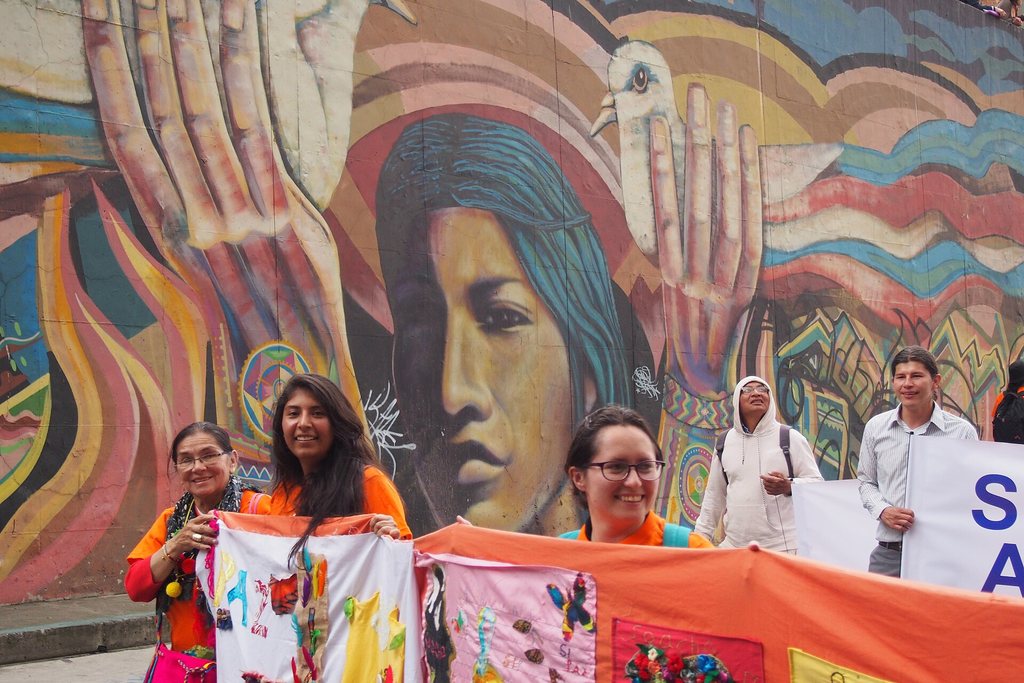
Featured Image: Thousands of Colombians took to the streets to support the peace agreement with the FARC, MAFAPO – Madres de falsos positivos de Soacha y Bogotá, CC BY-SA 4.0, via Wikimedia Commons
