

With 3.6 billion users across platforms such as Instagram, Facebook, and WhatsApp, Meta holds a monopoly over the attention economy. The company is uniquely positioned to influence people’s perspectives worldwide. Meta’s social media algorithms decide what content is suppressed or promoted to users. Time and time again, Meta’s apps have proven to be powerful tools for political communication in electoral campaigns.
In the 2026 Brazilian presidential election, two candidates competed: right-wing candidate Flavio Bolsonaro and left-wing incumbent Luiz Inácio Lula da Silva. Flávio Bolsonaro represents the Liberal Party (PL). He is backed by the United States, is openly pro-Israel, and is supportive of controversial Argentinian president Javier Milei. During his campaign, Bolsonaro stated his intent to sell Brazilian natural resources to foreign investors, build data centers, and reform the country’s constitution. Bolsonaro stated at the American Conservative Political Action Conference (CPAC) that Brazil could play a key role in reducing U.S. reliance on China for rare earths. He also promised to pardon his father, former far-right president Jair Bolsonaro, currently serving a 27-year sentence for plotting a coup following his loss to Lula in the 2022 election. Flávio plans to follow in his father’s footsteps: Jair Bolsonaro infamously green-lit the rapid destruction of the Amazon rainforest in favor of raising GDP. Luiz Inácio Lula da Silva, Flávio Bolsonaro’s left-wing counterpart and current president of Brazil, ran for his fourth and last term as leader of the Workers’ Party (PT). In earlier terms, Lula successfully paid off debts owed to the International Monetary Fund (IMF) and expanded the Bolsa Família social welfare program. Under Lula’s leadership, deforestation of the Brazilian Amazon reached its lowest rate in decades in 2026. Most recently, he passed a constitutional amendment replacing the six-day workweek with a five-day workweek for all Brazilians.
Eleven days ahead of the general elections, Lula da Silva’s Facebook page and advertisements were disabled. On October fourth, Flavio won the first round with 47% of the vote, a slight lead over Lula with 45%. Was foul play involved?
Lula da Silva suggests the U.S. used social media to interfere in this election. In a complaint filed with Meta regarding this issue, Lula’s campaign lawyers claim that Bolsonaro received unfair algorithmic recommendations and that the demotion of the ads tilted the scales in Bolsonaro’s favor. They also highlighted the closeness of the vote, indicating that the impact on election results may be significant. Meta denies any preferential treatment, stating this was not an isolated incident but rather a generalized glitch on the platform. Following Meta’s unsatisfactory response to the lawyers’ demands, the complaint escalated to electoral court, where Lula’s legal team won. Justice Marco Aurelio Belizze ruled that Meta should face a 500,000 reais fine for each day that the company tampers with the reach of political content in favor of one candidate or the other. Internal Meta messages acknowledge restrictions on Lula’s account barring him from boosting posts during approximately 24 hours on October 9th. On October 19th, a new ruling doubled the original fine, as a result of Meta’s refusal to comply. CNTRL+Z, an organization concerned with big tech regulation in Brazil, claims that over 1,100 pro-Lula accounts have been banned, restricted, or had their reach diminished.
Foreign interference in elections is not a new phenomenon, but social media proposes a new, more covert method.
In Romania’s 2024 election, independent far-right pro-Russian candidate Călin Georgescu rose to prominence using TikTok, though the platform denies hosting any political advertisements. Romania’s National Defense Council found 20,000 TikTok accounts linked with the algorithmic promotion of Georgescu’s campaign, and Digihumanism reports 48 political advertisements for Georgescu in TikTok’s Commercial Content Library targeted to around 300 000 users. This loophole enabled Georgescu to post political advertisements without disclosure. The election was later canceled as a result of possible Russian interference.
In Germany, falsified videos showing the far-right Alternative for Deutschland (AfD) missing on ballot pages circulated ahead of the 2025 elections, fabricating outrage among supporters. A portion of these videos have been traced back to the Russian group Storm-1516, which is also linked to interference in the 2024 U.S. election.
Jair Bolsonaro also famously used WhatsApp as his platform of choice to spread misinformation during and following his 2018 election. Bolsonaro’s “Office of Hatred” (Gabinete da raiva) was responsible for running disinformation campaigns on social media against his political opponents. A similar online campaign was used to manufacture consent for his disastrous handling of the 2020 COVID-19 crisis, which resulted in hundreds of thousands of deaths in Brazil.
Earlier this year, Amnesty International conducted an experiment in which 15 Portuguese-language advertisements containing disinformation about Brazil’s presidential election were submitted to Facebook. A London-based account solely dedicated to this purpose was used, and they were not declared as belonging to any of Facebook’s “Special Ad Categories”. These posts were intentionally crafted to echo common authoritarian rhetoric and violate Facebook’s misinformation policies, except for one “neutral” ad that contained factual information. Facebook approved eight ads containing false or inaccurate information. The seven others, including the “neutral” ad, were rejected by Meta on the basis that they consisted of “Ads about social issues, elections or politics”, which require further identity verification. There was no mention of misinformation. Facebook allowing political advertisements to be posted from outside of the country is concerning in itself, but the failure to detect misinformation exposes great negligence on Meta’s part.
Though he previously had no clear political affiliation, it seems Meta CEO Mark Zuckerberg has taken a page out of Elon Musk’s book and has aligned himself with the current Trump administration. This might be a mutually beneficial relationship: it allows him to influence AI policy in the United States and avoid testifying at Senate committee hearings. In exchange, Trump has the head of the world’s most influential platforms as an ally.
Donald Trump previously supported Bolsonarism, claiming in July that he would reduce the 50% tariff imposed on Brazil in exchange for Jair Bolsonaro’s release. It is no secret that the election of Flávio Bolsonaro, who fled to Miami, Florida, following his loss, would have been in the interest of U.S. investors and of the Trump Administration. This is happening amidst the strangling of the Cuban economy and the recent attack on Venezuela/capture of President Nicolas Maduro, both U.S. attempts at coaxing regime change in left-wing-led Latin American countries. These events all follow from Trump’s “Donroe Doctrine”. Brazil itself was the victim of a U.S. backed coup in 1964, when Joao Goulart, a pro-labor president, was overthrown and the country was launched into a two-decades-long military dictatorship.
Countries should not be forced to retroactively create policies for a recurring issue affecting democracies worldwide. Fines are insufficient when dealing with companies of this scale and effectively put a price on election interference rather than forbidding it. International social media giants should be held accountable and appropriately sanctioned for enabling election-related disinformation and foreign interference, especially given the ever-increasing reliance on social media for news.
Edited by Bérénice Louveau
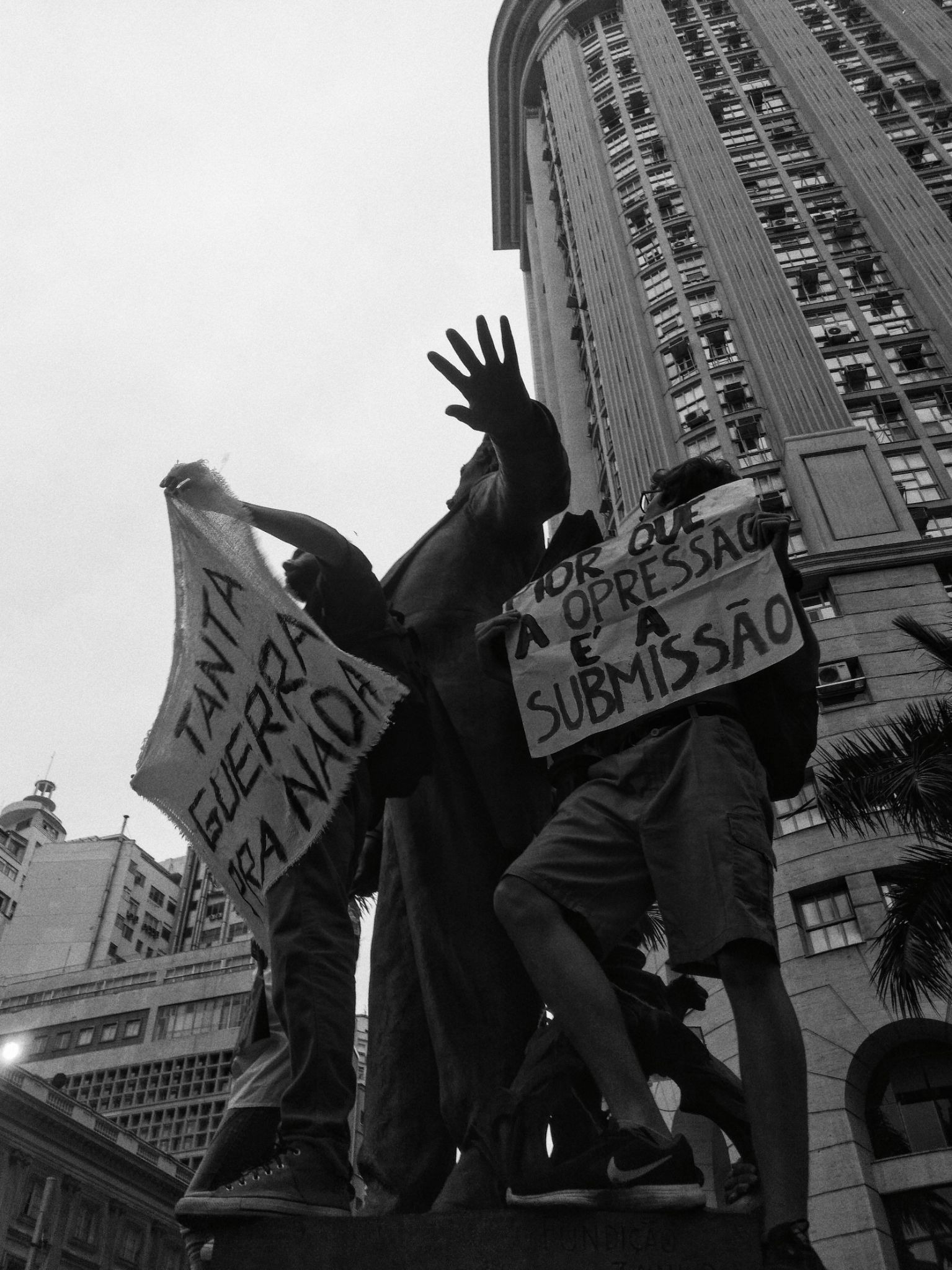
Featured Image: Untitled courtesy of Michelle Guimaraes