

When speaking about the country’s national security, analysts frequently prioritize Iran’s nuclear program, regional proxy networks, missile capabilities, and conflict with Israel and the United States. International evaluations of the security of the Islamic Republic have long been influenced by these concerns; however, some of the regime’s greatest enduring problems come from within its borders.
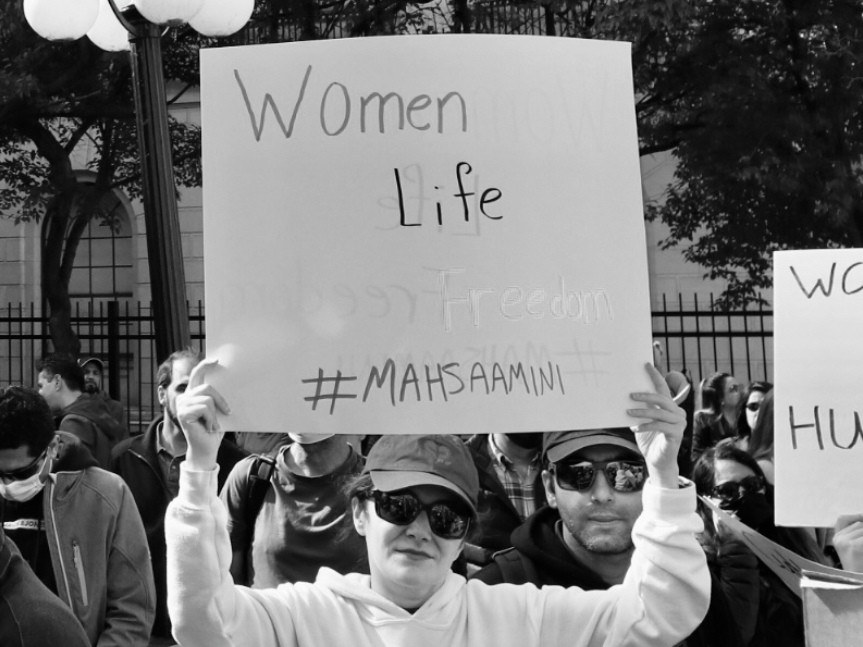
Since 2022, the Women, Life, Freedom movement has contested the foundations of the Islamic Republic’s political authority. What began as protests against legal regulations requiring women to wear the hijab evolved into a more general rejection of the state’s power to control individual liberties and public life. The movement exposed a fundamental weakness in Iran’s political system: that maintaining control does not always equal political legitimacy.
This distinction has become more crucial as the conflict between the United States and Israel has escalated. By portraying dissent as a threat to national security or an extension of foreign intervention, external confrontation can bolster the Iranian government’s immediate capacity to repress opposition. However, this kind of repression can also exacerbate the problems that gave rise to resistance in the first place. Iran thus faces a challenging security paradox; actions meant to maintain the regime temporarily could jeopardize its long-term political stability.
Why Women’s Resistance Threatens Regime Security
The regulation of women’s rights and freedoms has long been a defining feature of the Islamic Republic’s political and ideological framework. Compulsory veiling became a significant manifestation of the state’s interpretation of Islamic principles and its control over public life after the 1979 revolution. Therefore, restrictions on women’s behaviour and attire were never solely matters of personal appearance. They represented the government’s more general claim to establish and uphold the nation’s social structure.
The relationship between political authority and gender became particularly apparent following the killing of Jina Mahsa Amini, a 22-year-old Kurdish-Iranian woman held by the morality police for allegedly violating mandatory hijab laws. A subsequent UN investigation found the state responsible and that Amini’s death in custody was both unlawful and entirely preventable.
Her death triggered demonstrations across Iran, under the banner of “Women, Life, Freedom.” Women cut their hair, removed their scarves in public, and participated in protests alongside men and youth. The campaign quickly expanded into a more comprehensive challenge to the political authority of the Islamic Republic.
This shift is significant in ways that transcend calls for legal reform. Public resistance raised a more fundamental question: does the state have the right to determine how people live?
The situation posed a problem for the Islamic Republic because its political authority depends partially on upholding an ideological order that permeates everyday life. Women openly opposed both specific legislation and the state’s authority to impose its perception of social and religious behaviour by refusing compulsory veiling.
The state’s response revealed the degree to which authorities regarded this resistance as a political threat. The United Nations fact-finding mission recorded widespread violations against demonstrators, such as illegal executions, arbitrary incarceration, torture, and sexual and gender-based violence.
However, resistance persisted even after large-scale demonstrations decreased. Human Rights Watch claimed that Iranian authorities continued to use digital surveillance to ensure compliance, confiscate vehicles, close businesses, and prosecute women who disobeyed mandatory veiling.
Ultimately, women’s resistance became a matter of regime security precisely because it questioned the state’s ability to impose and uphold its ideological order rather than merely opposing individual government policies.
From Domestic Dissent to National Security
This conflict has taken on a new dimension as a result of Iran’s recent intensifying conflict with Israel and the United States. The confrontation with Israel in June 2025 and the wider war that started in February 2026 made it possible for internal resistance to be portrayed through the lens of national security, which raises the question of: What happens to political opposition in the face of an external military threat to an authoritarian regime?
For the Islamic Republic, international conflict provides an opportunity to link domestic opposition to foreign adversaries. Political dissent can be defined as actions that jeopardize national unity during a time of military vulnerability, rather than just disagreeing with government policies.
This strategy became evident after the hostility in June 2025. After June 13th, Iranian authorities detained almost 20,000 people, including journalists, human rights advocates, political dissidents, and members of minority groups, according to a joint investigation by Human Rights Watch and Amnesty International. Authorities justified widespread arrests and increased repression by citing national security and alleged cooperation with Israel.
A more recent Reuters investigation documented how, following protests in January 2026, Iran’s security forces, judiciary, and state media coordinated attempts to intimidate political opponents. Executions, televised confessions, and closed-door trials all led to an environment where opposition has progressively worse repercussions.
These developments illustrate the concept of securitization, which explains how political players try to rationalize actions that might otherwise be deemed unacceptable by framing specific concerns as extraordinary security risks. This concept explains how political players might reinterpret domestic resistance in Iran during times of foreign conflict. The administration shifts the conversation away from political rights and freedoms and toward the purported need to preserve national life by linking dissent to hostile foreign powers.
The ramifications are especially important for women’s resistance. Amnesty International recorded remarks made by high-ranking Iranian authorities blaming foreign adversaries for women’s failure to comply with mandatory veiling. This framing makes opposing the state’s control over women’s behaviour more than just a civil disobedience act; it can also be seen as a component of a larger threat to national security.
Importantly, Iran faces real external military threats. However, the mere fact that those dangers exist does not prove that nonviolent domestic opposition poses a security risk. The distinction is important because it shows how international conflict can create more reasons for suppressing political protest.
The Authoritarian Security Paradox
Increased repression can initially seem to bolster the Islamic Republic because arrests, surveillance, and the possibility of punishment can lessen overt dissent and deter protests. During wartime, these actions could assist the government in maintaining control over domestic political activities. Regime legitimacy and control, however, are not synonymous.
While legitimacy refers to whether or not the people accept the state’s authority as justified, control relates to the state’s capacity to uphold its decisions and quell opposition. A government can maintain coercive authority without broad public approval of its political principles.
Iran serves as an example of this difference. The Women, Life, and Freedom movement contested the state’s power to control women’s bodies, conduct, and public involvement. Suppressing protests could reduce opposition, but it does not restore public trust in the political system.
Instead, repression could deepen the grievances that initially sparked resistance. Citizens may grow more estranged from state institutions when nonviolent demands are answered with violence or imprisonment.
Nevertheless, diminishing legitimacy does not always result in regime collapse. Coercion, institutional control, and political structure allow authoritarian governments to endure widespread discontent.
Therefore, the Islamic Republic’s continued survival should not be considered proof that its crisis of legitimacy has been addressed. Its security dilemma lies in the possibility that policies that bolster short-term control could also jeopardize long-term political stability.
Why Gender Belongs in the Study of Regime Security
Iran demonstrates why studying international security and gender are intrinsically connected. Women’s resistance is more than just a domestic social problem that coexists with interstate conflict. Instead, it challenges the ideological foundations of the state’s authority as it becomes more intertwined with the government’s reaction to external threats.
The Woman, Life, Freedom movement demonstrated that military prowess, territorial defence, or relations with foreign adversaries are not the only ways to understand political security. It also depends on how a government interacts with the populations it claims to represent.
The Islamic Republic’s ability to defend repression may be strengthened by external war, but the political grievances that initially need suppression may not always be resolved. Ultimately, Iran’s experience poses a more general dilemma for authoritarian security: is it possible for a government to strengthen its defences while also eroding the legitimacy that underpins its long-term stability?
Edited by Carly Waiz
Featured Image: Taymaz Valley from Ottawa, Canada, CC BY 2.0, via Wikimedia Commons
