
Written by : Abigail Francis
Edited by: Carly Waiz
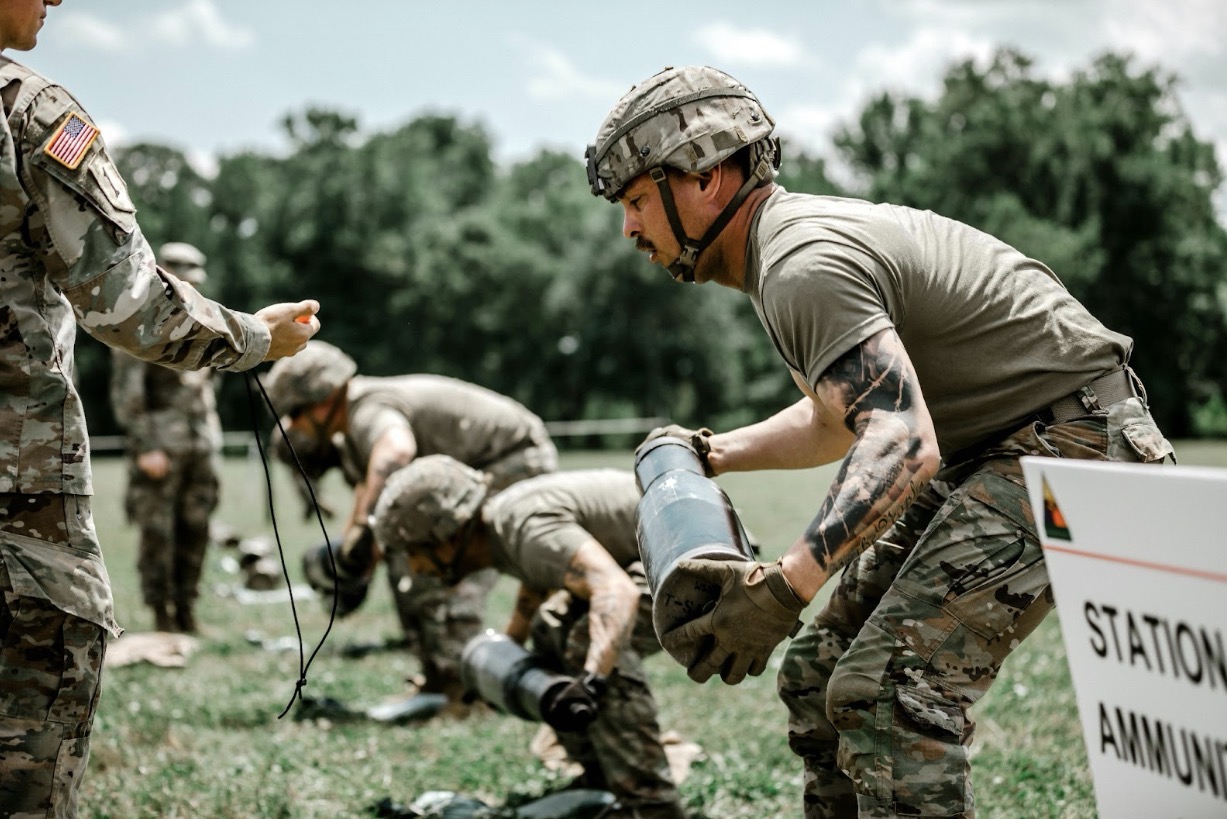
Gendered roles in war are intensely consistent across all known human societies. Almost all historical cases of war-making have been met by leveraging strong gender norms to create troops of fighters who are almost exclusively male. The ongoing relationship between men, masculinity and violence is a tumultuous one. Taking, for instance, soldiers (who are primarily men) are ingrained in a state system of a legitimized monopoly over the use of violence. The morality of not killing another human no longer applies, and in fact, in military settings, it’s praised. This calls into question where this bend in our moral code comes from and how soldiers can implement traditionally masculine gender roles to place “fear” into the enemy, according to one 2025 military recruitment video from the United States government.
Feminist international relations scholars argue that the vast majority of soldiers being men does not mean that men are intrinsically militaristic and, by contrast, women are naturally peaceful. The link between masculinity and the military is not one of biology but is performed and maintained for the purpose of waging war. Because of this, it is important to investigate militarized masculinities as a dynamic social construct rather than an innate concept. These gender roles are revealed through our attitudes, our behaviour and the relationships we have with each other. Soldiers perform, to one of the highest degrees, their perception of what their gender is “meant to do”.
Before training even begins, an individual’s act of joining the military can be a way to prove the success of such gendered roles on an internal level, but also externally, to those around them and to the state itself. The military works in tandem with these individuals, displaying the utmost amount of strength in hopes of recruiting men seeking to prove and appeal to their masculine identity.
Once in training, soldiers are praised for their resilience, tolerance and minimization of pain and hardship. They are taught to lack empathy and are encouraged in their toughness. For instance, on a question and answer period following a 2018 speech to students at the Virginia Military Institute, former Marine and former U.S. Secretary of War Jim Mattis characterized infantrymen as, “…cocky, they’re rambunctious, they’re necessarily macho, and it’s the most primitive — I would say even evil environment.” Here, Mattis strongly insists that to be in the infantry, you must outperform your gender into a hypermasculinity (“an exaggerated adherence to traditional male gender roles”). Soldiers are trained to commit state-sanctioned violence against other men and routinely engage in high levels of risk-taking behaviour, embodying a gender performance that is far more than the typical. The military allows, through the power of the institutional state, individuals to legitimize an extreme inflation of masculinity in a way that is positive and celebrated within society. Soldiers then become the result of the socialization they are exposed to.
Training develops an exaggerated ideal of manhood, a hegemonic hypermasculinity, that relies on the devaluation of others, such as women. Through the creation of a hero or protector, as many soldiers become known by the state they represent, there also must be a counterpart. In other words, the protector is made in relation to and in contrast to those who cannot help themselves, specifically femininities. We see this often in the media, whether it’s through the superhero saving their love interest or even as justification for war, like the US government’s push to invade Afghanistan to help “save” Afghan women. The U.S. invasion of Afghanistan mobilized a duty-based humanitarian narrative that simultaneously justified large-scale intervention and reproduced gendered hierarchies, positioning women as incapable of self-emancipation. Every damsel in distress needs their hero, and neither can exist without the other. But in doing so, neither can cross into each other’s spheres of influence. In fact, for men in military service, oftentimes, there is no greater insult than being compared to a woman. Words like “sissy”, “a bunch of ladies”, and “pussy” are often wielded by higher-ranking military officials to motivate men to embody hypermasculinity when they are seen as being too weak.
The hypermasculinity of the military is the faucet of the state institution. The western state itself, one of sovereignty, is in parallel to the idea of the sovereign man, one that is an autonomous and rational actor. Crucially, the state is associated with traits that are culturally constructed as masculine, thereby producing a masculinized conception of the nation in which political authority and collective voice are framed through a male lens. The secure, sovereign neoliberal state values a vision of masculinity defined by protection and hard power, superseding care based and relational approaches. For example, during the War on Terror, Osama bin Laden often taunted the US for becoming a “weak horse”, a superpower that was soft and too feminized; an empire destined for collapse.
Although the militarization of masculinity can drive men to fight and kill in war, there are also consequences to this system of knowledge. Hypermasculinity can be seen as a type of reactionary masculinity that “arises when agents of hegemonic masculinity feel threatened or undermined, thereby needing to inflate, exaggerate, or otherwise distort their traditional masculinity”. This dynamic is evident not only in military training camps but also in positions of political power, most notably in the performative displays of masculinity by world leaders such as Donald Trump through belittling social media posts, and Vladimir Putin through highly publicized images of physical dominance, extreme sports, and bare-chested horseback riding. This type of masculinity can also cause political leaders to feel as though they need to prove their masculinity time and time again, sometimes by violent means. Structures that produce hegemonic hypermasculinity also tend to reinforce patterns of abuse and aggression that can manifest in violent and/or sexually abusive ways from individuals.
Conforming to a militaristic structure enables service members to access new levels of cultural capital and relative power. Military success in most countries can bring advantages off the battlefield, such as high societal recognition and political success. However, this is often unattainable by women, as militaristic institutions are structured around masculinized norms that systematically privilege male participation and recognition. Feminist scholars argue that military valour functions as a gendered form of capital, unevenly distributed through institutional practices that marginalize women’s contributions. Consequently, rather than serving as a site of social mobility, militarization reproduces existing gender hierarchies by restricting women’s access to the symbolic and political rewards that are attached to military success.
Lastly, not only does hegemonic masculinity devalue women, but also other men or subordinated masculinities. These are men who exhibit masculinity that is different from traditional forms and/or are othered by race or sexuality. For example, between the 1950s and the 1990s, the Canadian Armed Forces (CAF) systematically purged gay and lesbian service members through coercive means. The CAF did this by the implementation of CAF Administrative Order 19-20 that actively enabled investigations into homosexuality and “sexual abnormality”, and the release of service members under the pretense of loyalty concerns. Through this line of thinking, subordinated men could not operate at the same skill level as the hegemonic man, thus compromising national security. Militaries can be seen to hypervalorize and idealize hegemonic masculinity as part of the core operating mindset that continues to define military service today.
A redefinition of masculinity in the military context could help thwart some of these consequences, but would require new ways to recruit and motivate individuals. Ways that do not rely on the privilege of hypermasculinity and denigration of femininity or any other group of people that do not fall under hypermasculinity’s neat categorization. These reconstructions, especially those that would enforce peace instead of fear, would have to incorporate other successful ways to be a man and to prove the importance of other characteristics of a human. An institution that privileges kindness, empathy and compassion as well as physical strength and mental toughness.