

Written by : Sophie Andrew
Edited by: Carly Waiz
On September 10th, 2025, Poland invoked Article 4 of the North Atlantic Treaty Organisation after reporting 19 airspace breaches by Russian drones. Different NATO members have taken separate approaches to Russia’s aggression in Ukraine. The E.U., being closest to the war, is responding to the ongoing threat with an announced potential €800 billion investment in Europe’s defense by 2030. Turkey has remained relatively neutral, but continues to be Europe’s largest buyer of fuel from Moscow. The US under Trump’s administration has proven to be an unreliable and unpredictable actor, as it has gone from voting with Russia on UN resolutions to criticizing Europe for continuing to buy Russian oil and demanding higher tariffs on Moscow.
These geopolitical developments test the strength of NATO; the more divisive the alliance is, the more advantageous it is to Russia. While most literature on NATO focuses on the enactment of Article 5, the inclusion of potential countries, and military spending, relatively less attention is given to their intelligence system, one of the most important foundations of military operations.
This article provides an overview of NATO’s intelligence structure and puts it in the context of the current war in Ukraine. Intelligence in this context refers to the collection and analysis of information provided to decision-makers, rather than artificial intelligence. While each nation typically has its own civil intelligence agency, for example, the U.S.’s CIA, the U.K.’s M16, and Germany’s Bundesnachrichtendienst, intelligence can also be formally pooled, as represented by the Five Eyes intelligence alliance.
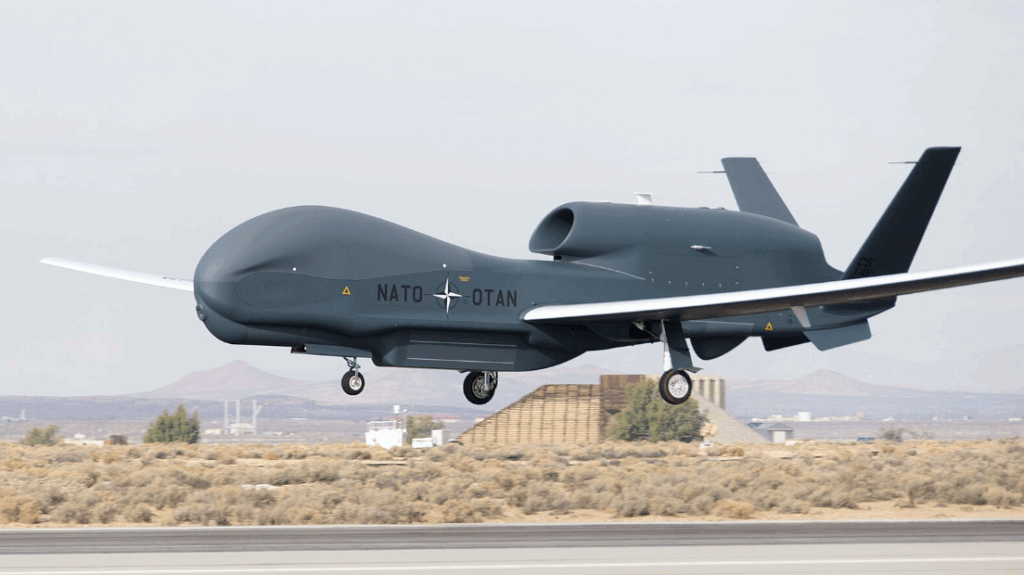
The NATO Intelligence, Surveillance and Reconnaissance Force (NISRF) represents the alliance’s collective intelligence body. It is based in Sigonella, Italy, a strategic and admirably symbolic location given its layered history as a sought-after Mediterranean island. The force consists of three main components: the Operations Wing, the Support Wing and the Training Wing. The NISRF produces their own intelligence from a fleet of five remotely controlled RQ-4D Phoenix drones. The base hosts approximately 450 personnel, which is marginal compared to the 22,000 estimated employees at the CIA (official numbers undisclosed) or the 5,000 employees in the MI6. Therefore, it is not surprising that only 25% of the data used for intelligence production comes from NISRF operations, the rest coming from national contributions.
The NISRF faces several limitations, including information-sharing, responsiveness to emerging technologies, and reliance on national contributions. To stay relevant and justify its role, the NISRF must adapt to new technologies such as satellites. However, arguments against investing in new alliance-wide satellite reconnaissance systems would highlight that many NATO member countries—such as the United States, France, the United Kingdom, Germany, and Canada—already possess sophisticated national space surveillance capabilities, raising questions about cost-effectiveness and potential duplication of existing assets. Yet, this raises a deeper issue: effective intelligence-sharing within the 32-member alliance. Member nations must willingly contribute intelligence, but such cooperation is often inconsistent—frequently limited, filtered, or censored.
The war in Ukraine stresses embedded flaws in NATO’s intelligence framework, testing both its legitimacy and operational coherence. Access to NATO classified information is conditional on full consent of the information originator, as specified in C-M(2002)49 (revised several times since its release, and is the core NATO policy document that sets out the principles and standards for protecting NATO classified information).
Therefore, even if NATO has vocally condemned Russia’s “brutal and unprovoked war of aggression against Ukraine,” they have limited power over autonomously supporting them through information-sharing, and remains superseded by the nation state. The lack of coherent decision-making was highlighted by European nations’ scramble to support Ukrainian intelligence when the US temporarily stopped sharing intelligence in March 2025. As of late, the US has agreed to give Ukraine intelligence on long-range missile strikes on energy targets in Russia.
Since NATO is not physically engaged in the war in Ukraine, the way it shares intelligence is a critical way to analyse its coordination, which also sends signals to opposing players. Russia is keenly aware of NATO’s flaws as it takes note of how information is being disseminated. When the alliance fails to garner legitimacy through authoritative power over information, this sends signals that it is not as strong as it wants to portray, and its deterrence therefore weakens. This all plays into legitimate questions of whether NATO would be prepared and operationally coherent in the event of a Russian invasion of NATO territory.